


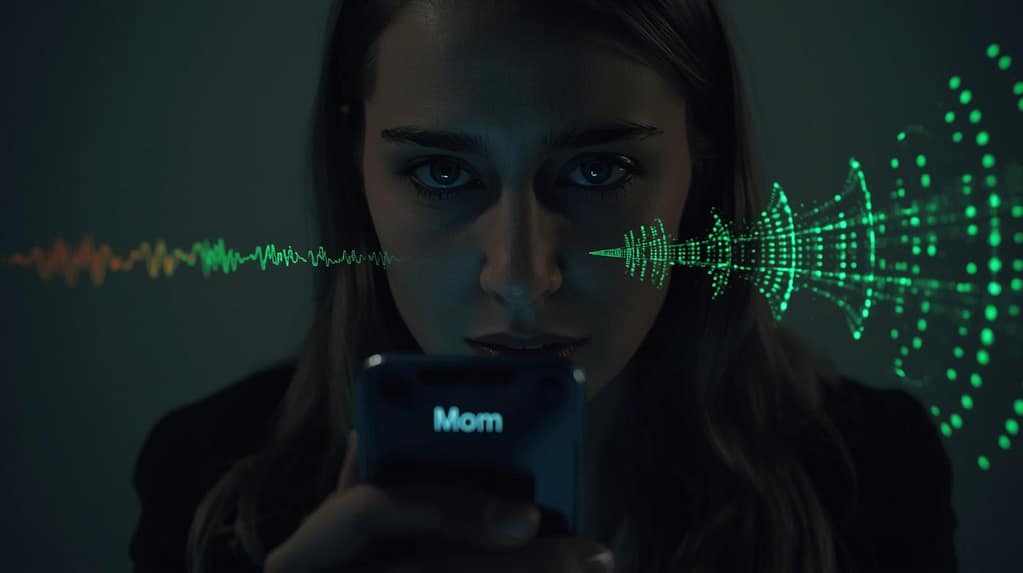
Deepfake Voice Cloning A sudden ring breaks the quiet. From the receiver, a cry with a familiar pitch and familiar words, but laced with panic. Not calm. Shaking. Insisting there was a crash, metal twisted somewhere off the road. Then comes the claim of being held by officers and unable to leave. Each phrase tightens around your chest. A sudden demand rushes at you to pay now or face consequences. Pulse racing, breath short. Before the phone goes silent, hands move toward cash without thinking.
A voice on the line – strangely familiar – belongs to no real person. This isn’t your kid speaking, just software mimicking speech. Taken without consent, it pulls from a brief clip uploaded months ago. Three seconds lifted from an old TikTok post shape something false. The sound feels close, but nothing about it lives.
This moment does not signal a future risk. Instead, it captures events unfolding at present – across the U.S., spreading globally. Back in December 2025, Fortune Magazine released findings showing how voice cloning passed a critical point, according to UC Berkeley’s Hany Farid: mere moments of sound can now produce realistic replicas, including authentic cadence, feeling, timing, breaths. Clues once spotted by listeners are fading fast. Some big stores now log over a thousand fake calls made by artificial intelligence every single day. A sharp rise appeared in voice scams using deepfakes – up more than 1,600% early in 2025 when measured against late 2024.
Massive financial damage has already occurred. During just the first three months of 2025, scams using deepfakes led to more than $200 million in global losses. By 2027, losses tied to AI-powered fraud could climb as high as $40 billion – this estimate comes from analysis by Group-IB’s threat intelligence team. One case involved engineering company Arup, which lost $25 million after a staff member in finance joined a virtual meeting where every person shown – including the CFO – was an artificial creation produced live by AI. Each person involved turned out to be pretending. Despite that, the worker sent the funds – nothing seemed off at first glance. He trusted what appeared real enough through voice and screen.
One way to avoid falling prey begins with grasping the mechanics behind such attacks. What follows covers each essential detail.
How voice cloning works in 2026
A single recording might be enough for fraudsters to mimic speech – realizing this changes everything. What seems like harmless audio could become a tool in their hands. Few people grasp how easily a voice gets copied these days. A short clip, once shared, may spread beyond control. Recognizing the minimal effort behind such fakes shifts perception sharply.
A single number pattern captures how someone sounds – researchers name this a speaker embedding, built from traits like throat shape, sound vibrations, voice rhythm, regional speech habits, along with flow and stress in spoken words. As little as three seconds of recorded talk lets McAfee Labs’ tests reach 85 percent similarity to the real voice; more audio pushes accuracy close to indistinguishable. Tools such as ElevenLabs, Resemble AI, Google’s Tacotron 2, and Microsoft’s VALL-E operate without coding knowledge, open to public use, mimicking intonation, loudness shifts, dialects, manner of delivery, feeling in expression, working across many tongues.
A recent global assessment on artificial intelligence safety, published in 2026, found voice-cloning technology behind many scams comes at no charge, demands minimal knowledge, yet allows full anonymity. Because it costs nothing, requires little ability, and leaves no traceable responsibility, misuse spreads quicker than other digital crimes. During one year alone – from 2023 into 2024 – online interest in no-cost voice-copying programs jumped by nearly two-thirds. People carrying out such fraud often lack advanced tech skills. Just three seconds of someone’s speech, an openly available app, along with a contact number, makes deception possible.
One way scammers operate relies on automated sound production. Instead of recording voices themselves, they type messages that software turns into spoken words, creating lifelike recordings with no human speaker present. Another method alters a person’s voice instantly while talking, shifting their natural tone into someone else’s during a live conversation. This live reshaping lets fraudsters react as if they were the imitated individual, responding to unpredictable replies. It is this responsiveness – driven by real-time manipulation – that creates such convincing deception. Questions get answers, pauses receive reactions, all shaped through disguised speech fed directly from the attacker.
Scam 1: The Three Second Social Media Trap
A single clip of you talking online might be enough. Not targeted attacks – but constant bots – sift through TikTok, then Instagram, then YouTube, then Facebook without pause. Audio leaks out in birthday clips. Vacation snippets carry tones. Even quick updates at your job spill sound into open channels. Criminal tools grab those pieces. Voice models form faster now. Most never notice until it is too late.
Minutes after grabbing an audio snippet, a copy of your voice emerges – ready to speak any phrase typed by the attacker. Not only does it mimic pitch, it learns how emotion shapes your tone: slight lifts at the end of eager sentences, pauses between thoughts, even regional markers unique to your speech. This replica adapts intonation like real excitement or urgency, matching patterns close friends would instantly recognize. Hearing it, family members respond without suspicion – their minds accepting the voice as familiar, trusted, unmistakably yours.
One clear takeaway stands out: every recording of your voice shared online increases risk. Speaking on camera isn’t off-limits – awareness matters more. Each clip posted may later serve as material for misuse, especially when voices appear often. Those constantly visible face-to-camera carry higher stakes simply by volume.
Scam 2: The Fake Family Emergency and the Grandparent Crisis
Right now, one scam hits harder than others when it comes to money lost by regular people across the U.S., and the numbers tell a troubling story. In 2023, adults who are older said they lost $3.4 billion because of fraud, which was 11% more than the year before, showing how fast these crimes grow – especially ones using copied voices. When looking at phone scams, those aged 60 and above stood out as the biggest target group; their reports reached 147,127 through the FBI in 2024, adding up to $4.8 billion gone, far surpassing every other age range in financial harm.
A sudden phone rings breaks the quiet – familiar words spoken in a child’s trembling tone fill the ear. Pressure builds fast, shaped by imitation so close it stings like truth. A story unfolds: metal twisted on pavement, officers shouting nearby, fear caught mid-scream. Money must move now, insists the voice, or consequences sharpen without delay. Older listeners feel the pull deep in their chest, memory mistaking mimicry for blood kin. Technology bends sound into weapon form, aimed at instinctive care. A different voice then joins – frequently claiming legal authority – to add weight and urgency through fabricated legitimacy. This role intensifies pressure by mimicking law enforcement procedures. Time shrinks under their control; questions get pushed aside before they form. Decisions must happen fast, leaving little room to check facts or reach out elsewhere. Every moment is shaped to block delays, doubts, even phone calls to others. Thinking clearly becomes nearly impossible when speed rules every exchange.
Time pressure becomes the tool of choice. Hearing a distressed child’s voice, a grandmother or father reacts without pausing to question what feels real. Emotion takes hold instantly – logic lags behind. Payment slips out before doubt has room to grow.
Beyond Dover, Florida, Sharon Brightwell gave fifteen thousand dollars to fraudsters mimicking her grandson’s speech, pressing urgency through fabricated crisis claims. Though recorded and shared publicly, her case mirrors countless others slipping under official notice – unreported due to embarrassment or unawareness of the deception itself.
Scam 3: The Corporate Boss Impersonation and the $25 Million Call
A new form of corporate deception emerged under a technical label – deepfake vishing, sometimes called AI-powered Business Email Compromise. Instead of fake emails alone, attackers now mimic voices and faces, advancing what was once basic CEO impersonation. By 2026, these methods had evolved past simple tricks into something far more damaging. Damage levels surpassed earlier digital scams by wide margins.
A recent study by Keepnet Labs reveals CEO scams driven by deepfake technology strike around 400 businesses daily as of 2026. Financial deception tied to synthetic media cost U.S. entities $1.1 billion in 2025 – up sharply from $360 million one year earlier. Data from Norton’s cybersecurity analysis in London shows attacks on banking institutions have surged more than twentyfold since three years ago.
One moment changed how companies think about digital trust – the 2024 incident involving Arup still echoes through boardrooms today. Instead of emails alone, fraudsters used lifelike simulations during what seemed like an ordinary meeting. Though suspicion arose early, visual confirmation lowered defenses quickly. Every voice heard, each face seen, belonged to synthetic replicas operating in sync. Money moved not because systems failed, but because perception was manipulated perfectly. A quarter-billion dollars vanished within minutes, routed beyond reach almost instantly. What felt like safety – seeing familiar colleagues speak – turned into the main vulnerability. Verification via camera proved useless once realism became weaponized. This event rewired assumptions: sight and sound together no longer guarantee authenticity. Security protocols built around human recognition suddenly looked outdated, even naive. Even cautious behavior could not prevent loss when deception matched expectation exactly. Now, firms question whether any live interaction can remain fully trusted under such conditions.
A steady rhythm marks each case of corporate deepfake scams. Urgency drives every demand, paired with demands for money moving fast to unfamiliar accounts. Silence is required – talk must wait till tasks finish, according to false instructions. Authority comes through familiar tones, mimicking voices deeply trusted by employees. In one instance, WPP’s chief executive appeared live on a fake video platform call, voice perfectly copied. An imitation audio message misled staff at a British energy business, resulting in €220,000 sent to a fraudulent provider believed to be legitimate.
Most businesses lack clear steps to respond when targeted by deepfakes – only one in five has a plan, reports Keepnet Labs. Losses grow steadily because readiness lags far behind risk. Despite rising dangers, many organizations remain unready.
Scam 4: The Bank Security Bypass and the Voice Biometric Failure
Fewer steps now mark the way people confirm who they are during calls – banks turned to voice recognition, rolling it out widely just in the past several years. Speaking certain phrases becomes enough; systems compare what is said to recordings kept on file. What made this appealing? A person’s vocal pattern behaves like a biological signature – one nearly impossible to copy, much like how fingerprints resist imitation.
By 2026, that assurance had already failed. According to SQ Magazine’s data on voice phishing, fake audio now matches real voices with more than 90% precision – undermining the very security measure meant to block such breaches. Instead of stopping fraud, voice recognition systems are being tricked by realistic replicas. Once a forged voice says the correct phrase, banks’ automated checks often accept it without question. Behind the interface, attackers alter login credentials, approve money movements, pull up private records, and sometimes remove large sums – all prior to any staff intervention.
One in ten banks saw deepfake voice scams drain more than a million dollars from single incidents during 2025. Financial organizations noted a surge – nearly a third higher – in fraudulent attempts involving synthetic media. Sound identical to real clients, impostor voices bypass systems built on vocal likeness alone. Instead of stopping fakes, these tools assume attackers won’t match the user’s voiceprint. A documented breach used artificial speech replication to siphon $35 million from a financial institution in the United Arab Emirates. Designed when mimicry wasn’t feasible, current voice checks fail where imitation becomes perfect.
One key takeaway stands out for people using voice-based banking: the safeguard once trusted now fails more often than assumed. Still, that failure does not leave balances exposed by default. What matters instead is learning which extra checks come after voice ID, then applying those rules so large transfers can’t proceed without further confirmation.
Scam 5: The Jury Duty Warrant and the Government Impersonation Wave
Unexpected trust gaps make family emergency cons effective, whereas scammers exploit assumed authority in government impersonation. A fabricated crisis drives the first; perceived power fuels the second. By 2026, one grows fast since connection to the target becomes irrelevant. Distance matters less when fear does the talking.
A sudden ring breaks the quiet – on the line, a voice sharp with authority says they’re from law enforcement. This figure claims failure to appear for jury service triggered a warrant set in motion today. Escape from swift detention hinges on one condition: payment of a fine by phone without delay. Authority in their tone comes not from training but replication – the speech pattern pulled from public clips, recordings released online after press events or patrols caught on body cameras.
One common pattern ties together fake calls from the IRS, Social Security, and Medicare – each swaps one bureaucratic setting for another but keeps the core approach unchanged. Thanks to AI-generated voices, these fakes now carry the rhythm and weight of genuine officials, sounding exactly how someone expects an agent to speak. Fear drives this version, unlike the family crisis hoax where affection takes center stage. Authority tones and urgent warnings shut down careful thought, pushing victims toward instant payments without pause. What feels like caution often turns into rushed compliance under pressure.
Imagine getting a call claiming to be from someone in power – both the FBI and FTC warn this could be a scam. Real officials never insist on instant payments by phone when handling legal issues. Instead of demanding cash right away, legitimate agencies follow clear procedures. Payments demanded through Bitcoin or gift cards? That behavior belongs to criminals, not public servants. Secrecy is another red flag; genuine representatives allow you to speak with trusted people. When told to stay quiet around relatives or attorneys, suspicion should rise immediately.
The Full Protection Protocol: What You Actually Need to Do
Knowing about scams helps – but only when it leads to clear actions. Security experts and police suggest these exact measures, forming a full defense plan against voice cloning tricks by 2026.
Start by picking a secret term your family agrees on – well ahead of any crisis. That step alone does more than anything else to block fake emergency scams. Use a phrase strangers could never guess, even if they searched social media or public records. It should stick in memory, even during high-pressure moments. Whenever someone claims a loved one needs help urgently, require that code word first. No move forward – not with cash, details, nor decisions – without hearing it clearly. A person using fake voices can’t access your secret code. Because of that gap, scams targeting family crises collapse before they start.
Hang up if someone asks for money or private data, no matter whose name appears on your phone. Spoofing a number takes almost no effort at all, thanks to how VoIP systems work. Your screen might show your bank, your supervisor, your kid, or even a federal office – yet that tells you nothing real about the caller. After such a call ends, get back in touch only through a number you already know is valid, one saved in your list or found via trusted directories. Doing this consistently stops most voice scams before they go further.
Someone should confirm every money movement using spoken agreement. What happened at Arup – like other cases where voice scams tricked firms – shows a shared weakness: approval steps used just one way to communicate. Now, each business ought to treat it as normal to block large payments without multiple checks. When someone asks by phone to send funds, staff need proof through another method entirely before proceeding. That second check keeps decisions grounded beyond digital mimicry. Back-contact the person using only their verified number. A message arrives via private mobile device instead. One internal tool handles follow-up actions separately. Compromise risk rules out repeating the original method – reuse invites exposure.
When handling money matters over video chats, confirm identities using separate channels. Because of what happened at Arup, treating live video as proof of identity is no longer safe. Organizations relying on virtual meetings for financial approvals need rules ensuring each person verifies themselves beforehand. Instead of trusting faces on screen, teams should share a unique code through another method – like a text to a private phone number – before logging in. That small step, done ahead of time, could have blocked the breach completely. Video alone does not prove who is speaking.
Start by checking how your institution handles voice-based verification through the banking provider. When voice recognition is part of the login process, inquire about safeguards active if that system fails or gets tricked. Protection should kick in even when audio checks are circumvented. For payments exceeding a defined amount, stronger confirmation methods must apply – like a temporary passcode delivered to an approved gadget. Another layer could involve verifying identity face-to-face before completing the transfer. Ensure these steps are clearly outlined in policies already in place.
Training staff ahead of time makes a difference, yet many wait until it is too late. Security findings show employee education cuts vulnerability to phishing and vishing sharply – by as much as 70 percent. When companies apply call-checking rules, cases of successful vishing drop nearly half. By 2026, firms resisting deepfake audio scams share common traits: they prepare workers through real-world examples, set firm steps for confirming requests, and normalize second-guessing transactions – even if the message seems to arrive from the top office.
The Uncomfortable Truth About Where This Is Going
Real-time deepfakes may soon mimic how someone moves, speaks, and sounds in live interactions, according to Hany Farid, an AI researcher at UC Berkeley, who shared these insights in a December 2025 Fortune piece. Detection will likely stop relying on human observation alone, since synthetic content is becoming too subtle for eyes and ears to catch. Instead, systems built into digital infrastructure – like encrypted proof-of-origin for media files and advanced cross-modal analysis tools – will have to take over what intuition once handled. Though people used to spot fakes by watching closely, that method might already be obsolete. What matters now emerges not from scrutiny but from behind-the-scenes verification layers. Trust shifts from seeing to knowing through technical validation.
Now is when safeguards like behavior-based alerts, safety phrases, return checks, and confirmation steps can actually work – since many attackers still count on regular human reactions instead of using live synthetic media at full strength. This shift is moving quicker than most realize.
Facing sharper threats ahead, defenses must take shape today – before the distance between how fast attackers evolve and how people respond grows too wide. What works later may fail completely if delayed past this window.
Reading our analysis of AI-driven cyber threats in 2026 reveals how machine learning reshapes digital defenses. A short clip – just three seconds long – can let attackers clone someone’s voice, so passing this information along matters. Anyone unaware should learn it, whether they’re at work or home.