


Google AI agents just changed the future of technology at I/O 2026. The assistant era is over. The agent era just started.
On May 19, CEO Sundar Pichai stood on stage at Google’s Mountain View headquarters. He announced what he called the agentic Gemini era. Translation: AI that does not just answer questions. AI that takes action autonomously.
The announcement includes Gemini Spark. An AI agent that runs continuously on dedicated virtual machines. It works while you sleep. It monitors your Gmail constantly. It takes actions on your behalf with minimal oversight.
This is not a chatbot upgrade. This is a fundamental shift in how AI works.
Google is betting $180 billion to $190 billion on this vision in 2026 alone. That is more than most countries spend on their entire military budgets. The company is reshaping every product around autonomous agents.
Here is everything announced at Google I/O 2026 that you actually need to know.
Google AI agents in actions
Gemini Spark: The AI Agent That Never Stops Working
Gemini Spark is the headline announcement. It represents Google’s vision for personal AI assistants that actually assist.
Spark operates 24/7 on dedicated Cloud virtual machines. It does not wait for you to ask questions. It monitors situations continuously. It takes action when needed.
The Gmail integration is what makes this powerful and concerning simultaneously. Spark can read your emails. It understands context. It can draft replies. It can schedule meetings. It can follow up on threads.
Pichai described it as your personal AI agent that navigates your digital life. It takes action on your behalf and under your direction. The key phrase is under your direction. For now.
Trusted testers get access this week. US beta for Google AI Ultra subscribers launches next week. Broader rollout timing remains unannounced.
The architecture is different from traditional assistants. Spark runs continuously, not just when summoned. It handles multi-step tasks in the background. It requires user approval only for high-stakes actions. Everything else happens automatically.
This creates obvious questions. What counts as high-stakes? Who decides? How much autonomy should AI agents have? Google did not answer these questions clearly.
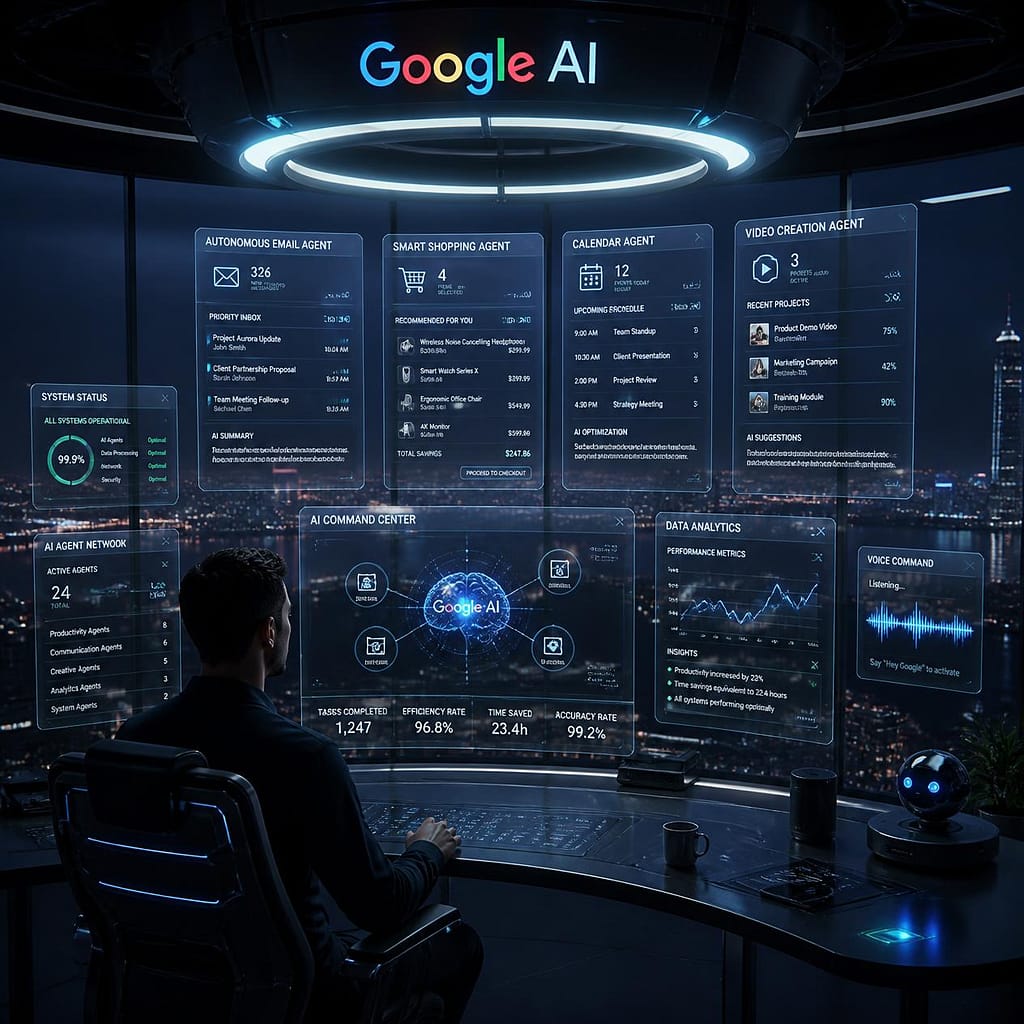
Google AI agents; Gemini Omni Can Create Anything From Anything
Google AI agents, Gemini Omni, are capable of generating anything from any material.
Gemini Omni is Google’s new multimodal world model. The company describes it as capable of creating anything from any input.
The technology works with images, audio, video, and text combined. You provide any combination. Omni generates video output. The demonstrations showed impressive results.
One example: upload vacation photos plus audio of waves. Omni generates a complete video combining both. Another: describe a scene verbally while showing reference images. Omni creates the video.
This is world modeling technology. The AI understands three-dimensional space, physics, lighting, and movement. It does not just paste images together. It simulates realistic environments.
Video generation from this combination of inputs was not possible six months ago. The improvement pace is accelerating dramatically.
Google focused the initial release on video creation. But the underlying technology works for any output type. Future versions will generate 3D models, interactive environments, and potentially full virtual worlds.
Gemini 3.5 Flash: Intelligence Meets Speed
Gemini 3.5 Flash launched as the first model in Google’s latest series. It combines frontier-level intelligence with Flash-series speed.
The model is available immediately via Google Antigravity platform. Also through Gemini API in Google AI Studio and Android Studio. Developers can start building today.
Performance reportedly rivals large flagship models. But response times match lightweight models. This combination was the holy grail Google chased for years.
The intelligence-speed tradeoff always limited AI applications. Powerful models were slow. Fast models were limited. Gemini 3.5 Flash breaks that pattern.
Early testing shows it handles complex reasoning tasks that previously required Pro-level models. But it responds in fractions of the time. This enables new application categories.
Real-time video analysis. Live translation with context. Instant code generation with full understanding. These applications need both intelligence and speed. Gemini 3.5 Flash delivers both.
Google Antigravity 2.0: The Platform Behind the Agents
Google Antigravity is the agent-first development platform powering everything announced at I/O. Version 2.0 represents complete platform unification.
Antigravity provides the infrastructure agents need to operate autonomously. It handles tool calling. It manages state persistence. It orchestrates multi-step workflows. Developers build agents, not chatbots.
The platform integrates lessons from Gemini CLI. Google rolled those insights into Antigravity CLI. Now developers have one unified toolchain.
The economic impact is substantial. Google processes 3.2 quadrillion tokens monthly now. That is seven times year-over-year growth. The API handles 19 billion tokens per minute.
More than 8.5 million developers build with Gemini models monthly. Antigravity makes those developers more productive by providing pre-built agent capabilities.
The shift from prompt engineering to agent orchestration changes software development fundamentally. Applications no longer just respond to inputs. They pursue goals autonomously.
Android Halo Brings Agents to Mobile
Android Halo is the new interface displaying live updates from AI agents. It shows agent progress directly on Android devices.
The interface provides persistent visibility. You see what agents are doing. You monitor task completion. You approve high-stakes actions. All without opening separate applications.
This solves a critical agent UX problem. How do users supervise autonomous systems? Halo provides ambient awareness without constant attention.
The design shows progress bars for multi-step tasks. It surfaces decision points requiring approval. It alerts when tasks complete. The interface feels similar to notification systems but purpose-built for agent workflows.
Android integration is strategic. Mobile is where most people spend digital time. Putting agents on mobile devices makes them accessible everywhere.
Google did not announce exact rollout timing. But Android Halo will launch alongside broader Gemini agent capabilities. Likely later in 2026.
Universal Cart: AI Shopping That Follows You Everywhere
Universal Cart represents Google’s vision for agentic commerce. An intelligent shopping cart working across all platforms and retailers.
The concept is simple. You browse products anywhere online. Cart tracks everything. It finds better prices. It applies coupons automatically. It optimizes checkout.
The AI understands context. If you are shopping for camping gear, it suggests compatible items. It checks reviews. It warns about sizing issues. It compares specifications.
But Universal Cart goes further. It can complete purchases autonomously when instructed. It handles form filling. It selects shipping options. It applies payment methods.
The cross-retailer functionality is what makes this powerful. One cart that works everywhere. No more juggling tabs. No more losing track of items across sites.
Privacy implications are substantial. Google would track all shopping behavior. Purchase history. Browsing patterns. Price sensitivity. Everything.
The commercial potential is obvious. Google could charge retailers for placement. It could take transaction fees. It could sell shopping data. The revenue opportunities are massive.
The $190 Billion Bet on AI Infrastructure
Google announced planned AI spending between $180 billion and $190 billion in 2026. This is infrastructure investment at unprecedented scale.
The money funds data centers. Custom silicon. Energy infrastructure. Talent acquisition. Everything needed to run AI at global scale.
Google unveiled eighth-generation TPUs at I/O. TPU 8t delivers nearly three times previous generation compute performance. Energy efficiency improved substantially.
These chips power the agentic AI future. Running persistent agents for billions of users requires massive compute capacity. Google is building that capacity now.
The spending reveals Google’s strategic priorities. The company is willing to invest at levels that exclude most competitors. Only Microsoft, Amazon, and potentially Meta can match this scale.
This creates oligopoly dynamics in AI. The companies with deepest pockets build the best infrastructure. They attract the best talent. They deliver the best experiences. Smaller competitors cannot compete.
What This Means for Every Google User– Google AI agents
The announcements at I/O 2026 affect billions of people directly. Google products will change dramatically over coming months.
Search is becoming agentic. Information agents will handle complex queries autonomously. You ask questions. Agents research answers. They synthesize information. They present conclusions.
Gmail becomes agent-powered. Spark reads emails continuously. It drafts responses. It schedules meetings. It follows up on requests. All happening in background.
Android gets ambient intelligence. Agents run on your phone constantly. They monitor context. They take actions proactively. The phone becomes truly smart.
Google Workspace transforms completely. Documents write themselves based on outlines. Spreadsheets analyze data autonomously. Presentations design themselves with minimal input.
The shift from tools to agents changes productivity fundamentally. You define goals. Agents handle execution. Your role becomes oversight, not operation.
The Privacy Concerns Nobody Is Discussing– Google AI agents
Agentic AI requires deep access to personal data. Gemini Spark reading your Gmail is just the beginning.
Agents need context to operate effectively. They need your calendar. Your location. Your contacts. Your browsing history. Your purchase patterns. Everything.
Google says users control permissions. But agent utility depends on access. Restrict access too much and agents become useless. Grant full access and privacy disappears.
The persistent operation creates continuous surveillance. Agents monitor constantly. They analyze everything. They build comprehensive profiles of behavior, preferences, and patterns.
Google promises user approval for high-stakes actions. But the company defines high-stakes. The boundary between routine automation and significant decision keeps shifting.
Data retention policies remain unclear. How long does Google store agent interaction data? Who can access it? Can it train future AI models? These questions lack public answers.
European regulators will scrutinize these systems intensely. GDPR compliance for autonomous agents presents novel challenges. Google will face regulatory pressure globally.
The OpenAI and Microsoft Response
Google I/O 2026 puts massive pressure on OpenAI and Microsoft. Both companies must respond quickly or lose ground.
OpenAI has ChatGPT Enterprise. But no comparable always-on agent system. No deep integration with email, calendar, and productivity tools. The company needs an answer fast.
Microsoft has Copilot. But it operates reactively, not proactively. Users must invoke Copilot explicitly. It does not run continuously like Gemini Spark.
The competitive dynamics just intensified dramatically. Google spent years behind OpenAI. Now Google might be leaping ahead with infrastructure OpenAI cannot match.
Anthropic, Meta, and other AI companies face similar pressure. The agentic era requires infrastructure investment beyond most companies’ capabilities.
Consolidation seems inevitable. Only companies with hyperscale infrastructure can compete. Smaller AI companies need partnerships or acquisitions to survive.
What Developers Need to Know
Google Antigravity 2.0 is available now. Developers can start building agent applications immediately.
The platform handles complexity developers previously built manually. Tool calling. State management. Multi-step orchestration. Error handling. All provided as primitives.
The economic model is consumption-based. Developers pay for compute resources agents consume. Pricing scales with usage. No upfront infrastructure costs.
The ecosystem is growing rapidly. 8.5 million developers building with Gemini monthly. This creates network effects. More developers mean more tools. More tools attract more developers.
Early movers have advantage. Agent applications are still novel. Market leadership is available. Companies that ship fast capture users.
The technical barriers are lower than traditional software. You define agent behavior through prompts and workflows. No complex codebases required. This democratizes AI application development.
The Jobs That Will Change First
Agentic AI affects knowledge workers immediately. Administrative tasks get automated first.
Email management disappears as human work. Agents handle it completely. Scheduling meetings. Following up on threads. Drafting responses. All automated.
Calendar management becomes fully autonomous. Agents coordinate schedules. They find meeting times. They send invitations. They reschedule conflicts.
Basic research gets delegated to agents. They gather information. They synthesize findings. They present conclusions. Human role becomes oversight.
Data entry and form filling vanish. Agents handle these tasks instantly. No human involvement needed.
Customer service transforms completely. Agentic AI handles routine inquiries. Human agents handle only complex situations.
These changes happen gradually then suddenly. Tasks shift from human to AI one at a time. Then entire roles disappear.
When This Actually Arrives
Google announced aggressive timelines. But deployment will happen in phases.
Gemini Spark trusted testing starts this week. US beta for Ultra subscribers launches next week. Broader availability likely comes Q3 or Q4 2026.
Gemini Omni video generation is available now in limited preview. Wider access rolls out over coming months.
Android Halo integration timing remains unannounced. Likely arrives with next major Android update. Possibly Android 16 later this year.
Universal Cart is furthest from launch. Google showed concepts, not shipping products. Expect 2027 availability at earliest.
The full agentic ecosystem requires years to mature. Google is showing direction. Full realization takes time.
Final Reality Check
Google I/O 2026 marks a genuine turning point. AI shifted from reactive tools to proactive agents.
The demonstrations were impressive. The ambition is clear. The investment is massive. Google is committed completely.
But challenges remain substantial. Privacy concerns. Regulatory scrutiny. Technical reliability. User trust. All need solving.
The agentic future is coming. Google just accelerated the timeline dramatically. Every other tech company must respond or become irrelevant.
The next six months determine who leads the agent era. And Google just made its move.